


New exhibit at St. Thomas sheds light on Jesuit slaveholding


A new exhibit at the University of St. Thomas sheds light on a disturbing period in history that received little public attention for decades and impacted Black Americans through generations.
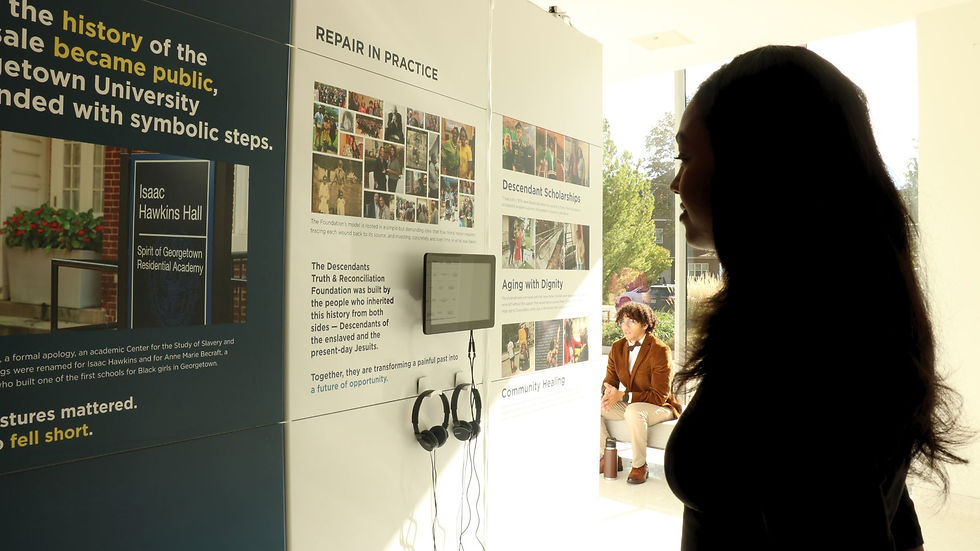
“What We Inherit: Truth, Repair, and a Promise to the Future” takes visitors back to 1838, when the Jesuits of Maryland, also known as the Society of Jesus, a Roman Catholic religious order, sold 314 enslaved men, women, and children to Louisiana plantation owners to pay Georgetown College's debts.
“You'll find the historical documents that list the bill of sale. It will list the conditions on which our families were sold,” said Monique Trusclair Maddox, a descendant of people enslaved by the Jesuits and the president and CEO of the Descendants Truth & Reconciliation Foundation (DTRF).
The exhibit displays a list of names included in the sale, pictures, historical records, and recorded testimony. Visitors can also follow the story of three featured ancestors. One is Cornelius “Neely” Hawkins, Nolan Stewart’s ancestor.
“Without Cornelius, you don't get Nolan,” Nolan Stewart said.
Stewart said he first learned about his family’s history through his grandfather, Joseph M. Stewart, but as he got older, he began to understand what happened.
“This is about my family. And it directly affects me and how my family raised me,” Stewart said.
Historical records say Hawkins was born at the Jesuit’s White Marsh plantation in Maryland around 1825 and was sold at age 13 in the 1838 sale. His grandfather, Isaac Hawkins, was the first name written on the list of those to be sold, but Cornelius never saw him again because Isaac was held at White Marsh after Cornelius was sent to Louisiana.
In 2017, Georgetown University renamed a campus building in honor of Isaac Hawkins. The building was previously named after Thomas Mulledy, the Jesuit and Georgetown president who helped orchestrate the 1838 sale.

Although some descendants discovered the history through ancestral tracing in the early 2000s, Maddox was one of many who learned about it through a 2016 New York Times article.
“I was leaving Mass at Our Lady of Grace Church in Edina and discovered this article on my phone and that's when I came to know the history,” she said.
Maddox said that while her mother looked through the manifest, she recognized the surnames from the Louisiana community where she had grown up.
“She uncovered one of her great-grandfather's names, who was three years old in 1838 on that list,” Maddox said. “So we reached out to Georgetown University immediately and said, 'We believe we're descendants.'”
According to DTRF, that child was Jackson Hawkins, Cornelius’s younger brother and Maddox's great-great-grandfather. Maddox also recognized the cemetery featured in the article where many of her own family members were buried.
“My father and my grandmother and many of my family members are buried in that cemetery,” Maddox said.
After the discovery, Maddox said people in the church and the Jesuits felt a lot of shame. She said learning the history drew her more into prayer than ever before.
“I really had to do a lot of soul-searching around, “What is it about this church that would make me want to stay?” Maddox said.
Thinking about her ancestors is what kept her faith strong, and she felt like she couldn’t let them down; instead, she worked to ensure that their stories stayed alive.
“I also wanted to be able to look those priests in the eye week after week and say, ‘Here I am. Look at me now. You cannot turn away from me,’” she said.
But she also wanted to forgive past wrongdoings and worked to collaborate with Jesuits to begin the repair.
Descendants and Jesuits created DTRF together. Maddox said the foundation works to fulfill promises made when their families were sold: educating children, caring for elders and the ill and helping them continue practicing their faith.
The foundation provides educational aid to descendants, senior home repair and community healing efforts.
“When we started working with the Jesuits, the Society of Jesus, we began by saying, listen to us, listen to what our needs are, listen to our stories,” Maddox said.
Sean Toole, a Jesuit priest and descendant outreach coordinator for DTRF, said Jesuits continue to benefit from past slaveholding and slave trading.
“This is not just my history, this is my present,” Toole said. “Here's an opportunity to acknowledge what is true and to invite other people into that truth, into that recognition, so then to be able to move forward towards greater healing as a result.”
The exhibit is free and open to the public daily from 8 a.m. to 7 p.m. through Nov. 7 at the Iversen Center for Faith on St. Thomas’s St. Paul campus.


Comments